

It’s a Tuesday in the slow stretch after the summer rush. Two techs are standing around a lift with nothing on it, a bay’s been empty since nine, and the phone has rung twice all morning, both wrong numbers. Nothing broke, and the work’s as good as it was in July. So where did everybody go?
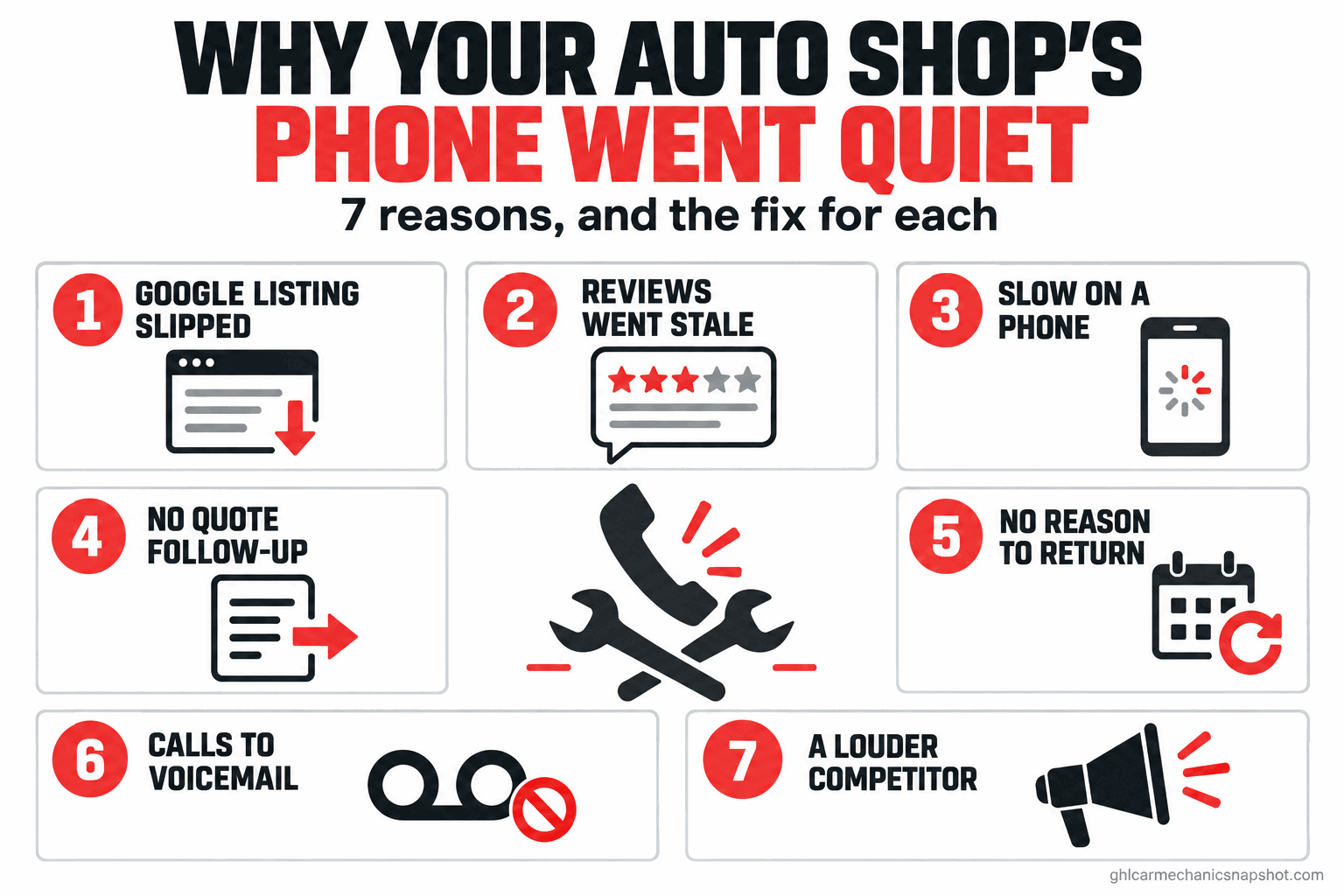
Here’s the short version. A quiet phone is almost never one thing. It’s your shop slipping out of the places where people find you, one quiet notch at a time: your Google listing drifted down, your reviews got old, your website loads like it’s 2011 on a phone, the quotes you handed out never got a follow-up, and your regulars forgot you exist until something broke and they called whoever showed up first. Below are the seven reasons, and what to do about each.
What’s on this page
- What a quiet phone is costing you
- How to tell which reason is yours
- Reason 1: Your Google listing slipped
- Reason 2: Your reviews went stale
- Reason 3: A slow website on a phone
- Reason 4: No quote follow-up
- Reason 5: No reason for regulars to return
- Reason 6: Calls going to voicemail
- Reason 7: A competitor got louder
- Steal this: the exact messages
- Run this for your size of shop
- The line that turns a legal text illegal
- Straight answers to the objections
- FAQ
What a quiet phone is costing you
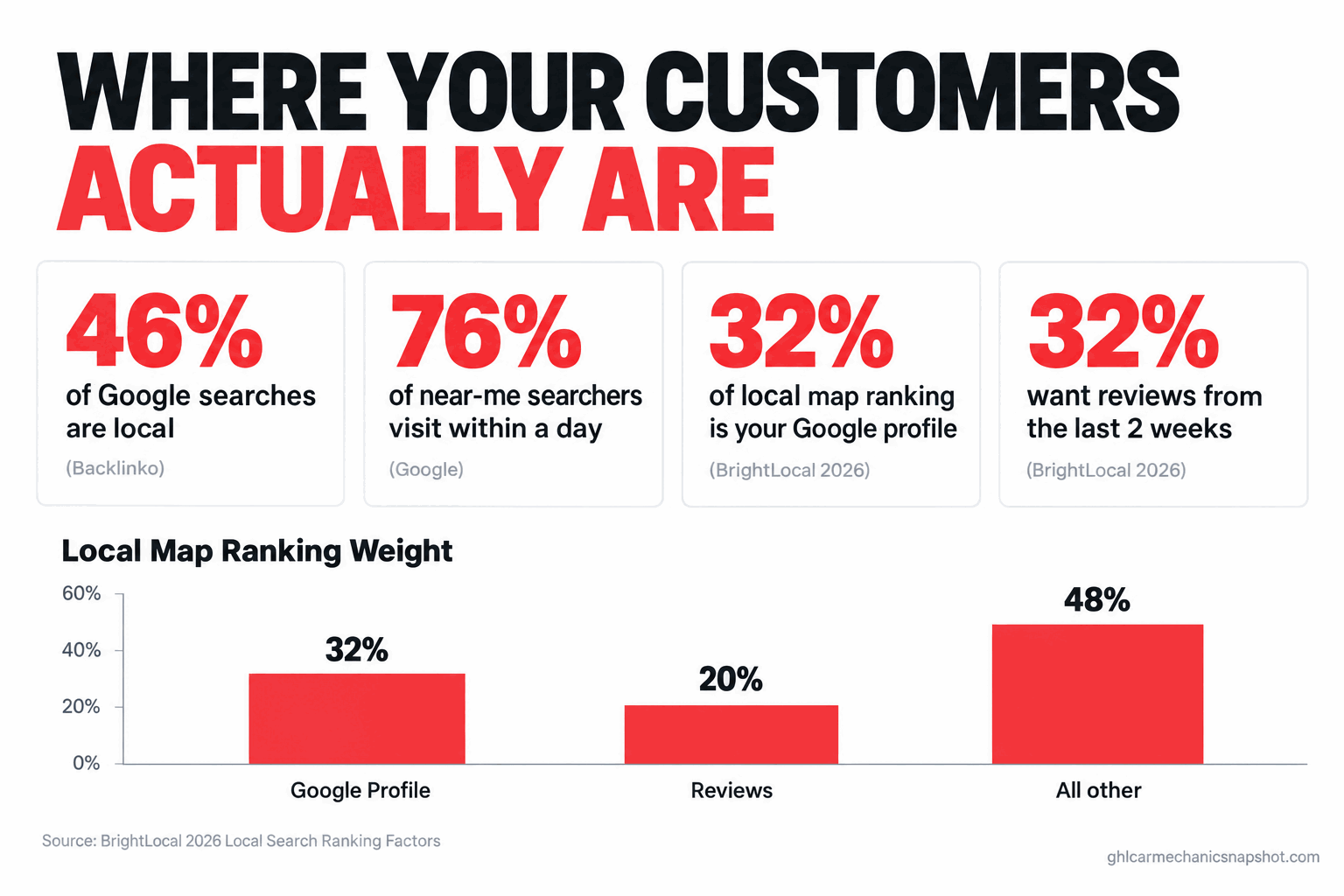
Start with the thing that should calm you down: demand didn’t disappear. People still break down and still ignore a check-engine light until they can’t. Nearly half of all Google searches have local intent, per Backlinko’s roundup of local search data, and when someone runs a “near me” search on their phone, 76% visit a business within a day, 88% within a week. So the money isn’t walking past because nobody wants a mechanic. It’s walking past because when they searched, your shop wasn’t the one that showed up, loaded fast, and was easy to call. Every one of those is fixable.
Sources: Backlinko local search statistics; BrightLocal 2026 Local Search Ranking Factors; BrightLocal 2026 Local Consumer Review Survey.
How to tell which reason is yours
Find the leak first. Grab your phone, open an incognito window, and search what a customer would type, like “brake repair [your town].” Then match the symptom on the left to the reason on the right.
| What you notice | The reason it’s probably | Jump to |
|---|---|---|
| You don’t appear on the map, or you’re on page two | Your Google profile slipped | Reason 1 |
| You show up, but your newest review is months old | Your reviews went stale | Reason 2 |
| You get found, but people don’t stay or call | Your website is slow on a phone | Reason 3 |
| You hand out estimates and never hear back | No quote follow-up | Reason 4 |
| Old regulars only show up when something’s broken | No reason to come back | Reason 5 |
| The phone rings when you’re closed or slammed, then nothing | Calls go to voicemail | Reason 6 |
| A newer shop keeps ranking above you | A competitor got louder | Reason 7 |
Most shops have two or three at once. The first three decide whether a stranger finds you; the last four decide whether the people who already know you come back.
Reason 1: Your Google listing slipped
When someone’s engine light comes on in your town, they don’t picture your bays. They see a map with three shops, and whoever sits on top gets the call. Your Google Business Profile decides your spot, and it’s the single biggest factor in local map rankings at about 32% of the weight, per BrightLocal’s 2026 ranking factors survey, with reviews second at 20%. A profile doesn’t crash, it drifts: your hours go wrong after a schedule change, you never added the services people search, you haven’t posted a photo in a year. Each small ding slides you out of the top three.
Share of Google local pack ranking weight. Source: BrightLocal 2026 Local Search Ranking Factors (released November 2025).
The fix. Claim and verify the profile. Set your hours right, holidays included. Add every service in plain words customers search. Load a dozen real photos. Keep it alive with a short post every week or two. It’s free and moves the needle more than anything else.
How it breaks. “Set it and forget it.” You fix it once, and months later your hours are wrong again because you changed them in your head.
Reason 2: Your reviews went stale
The next thing a stranger checks is your reviews, and how recent they are. In BrightLocal’s 2026 consumer survey, 32% of people said they look specifically for reviews from the last two weeks, up from 20% the year before. A 4.8 whose newest review is from last spring reads as “is this place even open?” And reviews happen by accident, with the angry customers far more motivated to type. The fix isn’t to beg. It’s to make asking a routine part of every job.
The fix. Ask every happy customer, every time, by text, a couple of hours after pickup when they’re relieved the car’s fine, with a direct link to your Google form. The exact wording is in the steal-this section, and there’s a deeper version in getting more Google reviews on autopilot.
How it breaks. Asking at the counter during pickup, when the customer’s rushing back to work and will “do it later,” which means never. And routing an unhappy customer to the public form instead of a private reply you can fix. Never fake or filter reviews in ways that break Google’s policies, which is a fast way to get suspended.
Reason 3: Your website is slow on a phone
Nearly all your “mechanic near me” traffic is a person in a parking lot, on a phone. If your site takes a beat too long to load, they’re already back on Google tapping the next shop. Google found that as a mobile page’s load time goes from one second to three, the chance the visitor bounces jumps 32%, from an analysis of about 900,000 mobile pages. Slow isn’t the only killer either: a number they can’t tap to call, a site that makes them pinch and zoom, no clear “book now.” Every one is a person who found you and left anyway.
If the site’s the leak, that’s the one fix here you may not want to do yourself. A fast, mobile-first site that puts “call” and “book” one tap away is the whole job of our done-for-you auto repair website service, from $117 a month plus a $597 one-time build.
Reason 4: You stopped following up on quotes
This is where the quiet phone usually hides. Think about last month’s estimates. A customer came in, you quoted the brakes, they said “let me think about it,” and they walked. How many did you call back? For most shops the honest answer is close to none, because the advisor’s slammed and a quote with no follow-up evaporates. The customer didn’t decide against you. The noise got better and the quote slid off their mind, and when it got worse they searched from scratch and called whoever popped up.
The fix. Every declined or unapproved quote goes into a simple sequence: a text a day or two later, another a week out, one more a few weeks after. We break down the whole thing in how to follow up on declined work.
How it breaks. Doing it by memory. If follow-up depends on a human remembering on a busy day, it doesn’t happen. It has to run on its own, which is the point of a system instead of a sticky note.
Reason 5: Your regulars have no reason to come back
Your best customers aren’t gone. They just have no reason to think of you until something breaks, which is exactly when they panic-search and land on someone else. A customer you already earned is the cheapest car you’ll ever book. You flagged the next brake service, they nodded, they left, and nobody reminded them, so they drift until a warning light forces their hand and the shop that sent a timely reminder, often the dealer, gets the visit.
The fix. A reminder cadence that goes out on its own by mileage, time, or the work you flagged, so it feels like a shop that remembers. We cover the timing and tone in service reminders that don’t annoy repeat customers, and the deeper story in why customers go back to the dealer.
How it breaks. Too often, or too generic. Blast everyone the same “we miss you” every two weeks and you train people to ignore you, or to reply STOP. The reminder has to be about their car, at the right interval.
Reason 6: Calls after hours and at lunch go to voicemail
Here’s a quiet one: the phone did ring, you just couldn’t pick it up. You were under a car, or it was 5:45 and everyone was wrapping. The caller got voicemail, hung up, and called the next shop, because a person with a broken car doesn’t leave a voicemail and wait. A missed call isn’t a missed call. It’s a booked repair at somebody else’s shop.
The fix. The moment a call goes unanswered, an automatic text goes back: “Sorry we missed you, this is the shop, what’s going on with your vehicle and when works to bring it in?” That catches them before they dial the next shop. We cover the mechanics in two-way texting for auto shops and the cost of missed calls in the phone rings but the bay stays empty.
How it breaks. No speed. If the text goes out twenty minutes later, they’ve already booked elsewhere. It has to fire in seconds, so it can’t depend on a person noticing.
Reason 7: A competitor simply got louder
Sometimes nothing’s wrong with you, someone else just got better at the six things above. A newer shop claimed their profile, asks for reviews, runs a fast site, and texts back every missed call. They got found first, by the same people who used to find you, because the slot on top of the map fits one shop.
The fix. You out-tend them: fresh reviews every week, a profile you post to, a site that loads, follow-up that runs on its own. The competitor beating you is usually just the one who kept going after everyone else quit.
Steal this: the exact messages
You need a handful of messages that go out at the right moment without anyone remembering, in your own words.
Set those five to run on their own and the phone stops being the only way a job gets booked.
Run this for your size of shop
Solo or two-person shop. You’re the advisor, the tech, and the one who should be answering the phone, which is exactly why calls go to voicemail and reviews never get asked for. Start with the two that run completely without you: the missed-call text-back and the review request. Fix your Google profile in one evening, and skip the rest until those are humming.
Mid-size shop, 3 to 8 techs with a front desk. Your advisor’s capable but slammed, so follow-up is what’s falling through. You’ve got the car count to make declined-work follow-up and service reminders pay fast. Put all five messages on a system and have your advisor work the replies.
Larger or multi-bay operation. Your problem isn’t any single message. Nobody owns the whole flow, so leads leak between the website, phone, counter, and follow-up. You need every message running and one pipeline where a lead is visible from first call to paid ticket.
The one line that turns a legal text illegal
Before you send a single automated text, understand the mistake that gets shops fined. Under the federal Telephone Consumer Protection Act, damages run $500 per text, and $1,500 if a court finds you did it willfully. A service reminder or appointment confirmation to a customer you’re serving is generally fine. The trouble starts when you mix in one promotional line.
You send a legal “your car’s ready” text and tack on “refer a friend for $20 off.” That one line can reclassify the whole message as marketing, which needs prior express written consent and instant STOP handling. Keep transactional texts transactional, keep promotions separate and opt-in only, honor STOP immediately, and register through A2P 10DLC. We walk through it with sample consent language in text message compliance for auto shops. None of this is legal advice, so run your setup past someone who knows your state.
Straight answers to the objections
“I don’t have time for marketing. I’m fixing cars.” The missed-call text, the review ask, and the follow-ups send themselves. You’re not adding a marketing job, you’re removing the “remember to follow up” job that already isn’t getting done.
“Won’t automated texts annoy people?” Only if they’re generic and too frequent. A text about their specific car, at the right moment, reads as a shop that pays attention. Relevance and timing are the difference.
“I already pay for Tekmetric or Shopmonkey or AutoLeap.” Good, those run repair orders well. The question is whether the texting, reviews, and follow-up are actually turned on, or a tab you’ve never opened. Plenty of shops pay for the tools and never send a single review ask.
“Will this really bring the phone back?” It brings back the jobs you’re currently leaking. It won’t invent demand, but demand is there, you’re just not catching it. The average shop bills around $132 an hour in 2026 per Tekmetric’s state labor data, so a handful of recovered jobs a month pays for the whole system.
Finishing the Tuesday
Back to those two techs and the empty lift. The quiet phone didn’t mean your town stopped needing mechanics. It meant that on the morning someone’s brakes started grinding, your shop wasn’t the one that showed up, or loaded fast enough, or texted back when they called at lunch. Pick the top two reasons that sound like your shop and fix them this week. Fresh reviews and a missed-call text-back alone will change what next Tuesday sounds like.
Frequently asked questions
Quiet-phone questions auto shop owners ask
Why did my auto shop's phone suddenly go quiet?
It's rarely one thing. The common causes are a Google Business Profile that drifted down the map, stale reviews, a slow mobile website, and no follow-up on quotes or past customers. Demand is almost always still there. Your shop just stopped being the one people find and call first.
How do I show up higher in the map results for mechanics near me?
Your Google Business Profile carries about 32% of local map ranking weight, so claim it, set accurate hours, list every service in plain language, add real photos, and post regularly. Reviews are next at 20%, so fresh ones lift you further.
Do old Google reviews stop helping?
They still count, but recency matters more than it used to. In BrightLocal's 2026 survey, 32% of people look for reviews from the last two weeks. A high rating with no recent reviews makes a shop look inactive, so aim for a steady flow of new ones.
What's the fastest way to fill empty bays in a slow stretch?
Work the customers you already have before buying leads. Text every missed call back within seconds, follow up on every unapproved quote, and send reminders to regulars who are due. Those recover jobs you're already leaking, faster and cheaper than advertising to strangers.
Is it legal to text my customers automatically?
Transactional texts like confirmations and service reminders to customers you're serving are generally fine. The risk is mixing a promotional line, like a referral offer, into a service text, which can reclassify it as marketing and trigger TCPA rules with damages of $500 per text. Keep promotional and transactional messages separate, honor STOP, and register through A2P 10DLC.